
TX ProChem’s molecular soil treatment neutralizes expansive clay permanently, protecting land investments before lots sell. For more than 30 years, the company has stabilized residential subdivisions and commercial parcels across Texas, Louisiana, Mississippi, Arizona, and Oklahoma. The patented ProChem Ionic Liquid Stabilizer alters clay behavior at the molecular level, eliminating Potential Vertical Rise risks and keeping construction schedules on track.
Why treat expansive clay before development?
Expansive clay soil causes more damage to Texas homes and buildings than floods, tornadoes, and earthquakes combined. Developers who skip pre-construction soil treatment inherit structural failures, warranty claims, and project delays that erode profit margins.
The threat lies beneath the surface. In high-risk clay regions like North Texas, expansive soils swell and shrink dramatically with moisture changes. This cycle creates unstable conditions that crack slabs and delay construction. A single season of heavy rain followed by drought shifts the earth enough to compromise foundations before framing begins. For developers managing multiple lots, the financial exposure multiplies with every untreated parcel.
How does ionic stabilization change clay behavior?
The ProChem Ionic Liquid Stabilizer alters clay at the molecular level. A two-year study conducted by the University of Texas at Arlington validated this patented solution. Researchers found the product effectively changed the polarity of clay soils by removing their negative charge. Electron microscopy verified the transformation. Without that negative charge, treated soil loses its ability to absorb water. The swelling and shrinking cycle stops permanently.
What makes chemical treatment different from over-excavation?
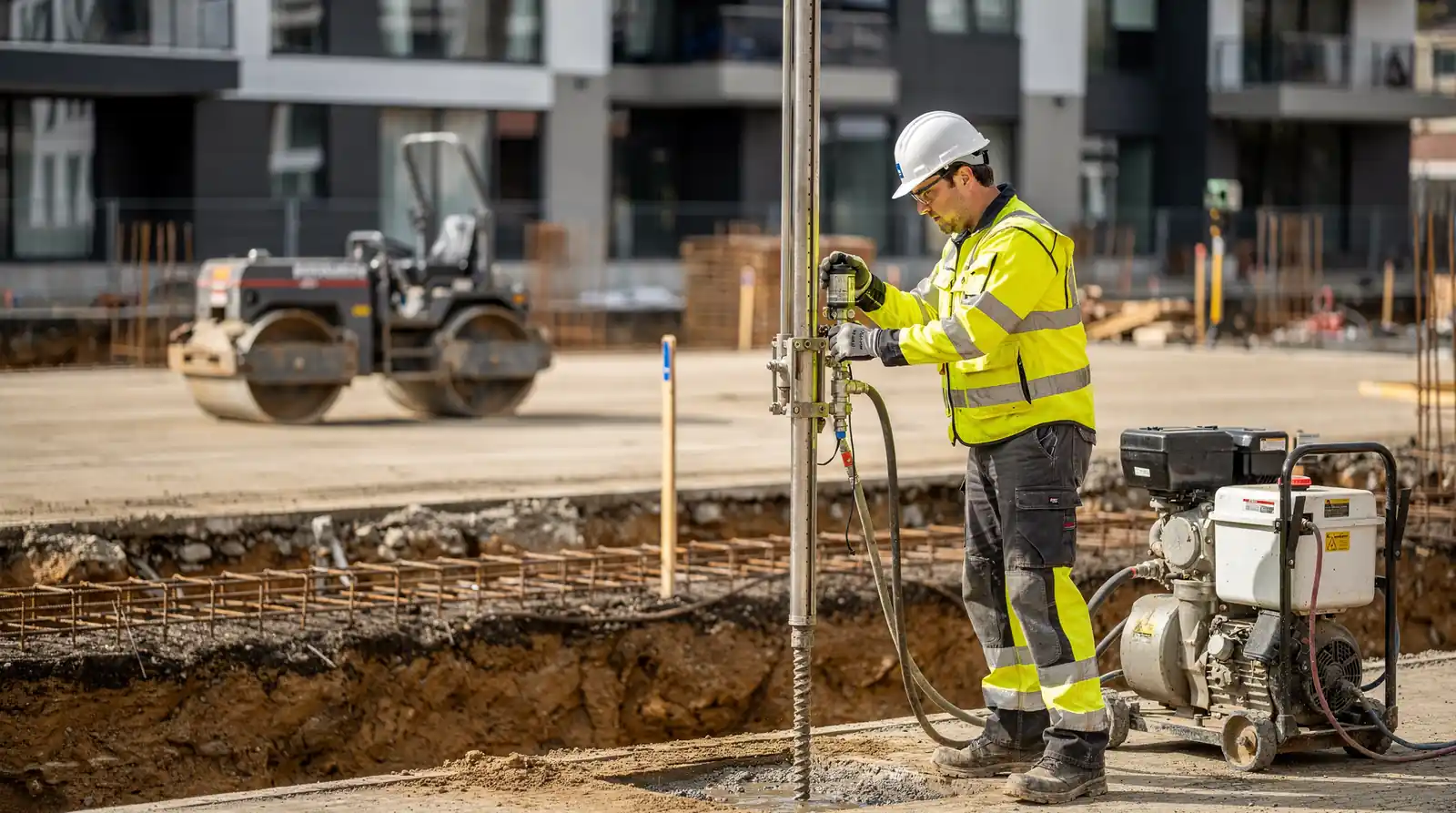
Traditional methods remove and replace problem soil. Chemical injection treats soil in place. Over-excavation requires hauling off expansive clay and importing select fill, a process that burns schedule time and budget. Soil stabilization for developers using ionic treatment eliminates those steps. Crews inject the stabilizer directly into native soil, treating up to 6,000 square feet per day per tractor. Lot readiness solutions that work with existing site conditions keep earthwork crews moving without interruption.
Developer site prep timelines stay intact when treatment integrates into the existing build sequence. ProChem for subdivisions applies the same commercial-grade science across entire neighborhoods, locking expansive clay in place before utilities and slabs go in. The result is consistent ground behavior regardless of weather extremes. Reduce construction delays by addressing the root cause of soil movement before it triggers punch-list nightmares and callback expenses. TX ProChem offers advanced ionic soil stabilization services that neutralize expansive clay beneath commercial pads, residential subdivisions, and custom pools.
How does chemical injection compare to traditional methods?
Chemical injection permanently alters expansive clay at the molecular level. Traditional methods simply manage the symptoms through physical barriers or excavation. Soil stabilization for developers demands a solution that eliminates risk rather than delaying it. TX ProChem’s ionic liquid treatment stops the endless cycle of swelling and shrinking for good, a claim no over-excavation or moisture barrier can match.
What makes chemical injection a permanent fix?
The treatment changes soil behavior irreversibly. A University of Texas at Arlington study confirmed the liquid ionic soil stabilizer reduces the Plasticity Index of treated clay. Lower plasticity means the soil loses its capacity to absorb water and expand. The company employs a permanent stabilization approach that keeps the ground consistent irrespective of weather conditions. Droughts and floods no longer dictate subgrade movement.
How does production speed compare on large sites?
Speed separates chemical injection from conventional developer site prep. Over-excavation requires hauling off unstable material and importing select fill, a process measured in weeks per acre. TX ProChem’s process handles up to 6,000 square feet per day per tractor. This throughput delivers lot readiness solutions that keep grading and foundation crews on schedule. ProChem for subdivisions integrates directly into existing earthwork sequences without adding days to the critical path.
Chemical injection permanently alters clay at the molecular level, while over-excavation physically removes and replaces problem soil, and moisture barriers only divert surface water.
The comparison clarifies why developers choose injection to reduce construction delays. Barriers fail when groundwater rises from below. Excavation costs escalate with depth and disposal fees. A single Build on Solid Ground with Prochemical Soil Stabilization treatment eliminates both variables. The stabilized subgrade accepts foundations immediately, with no cure time and no weather window restrictions.
What does lot readiness look like with ionic treatment?
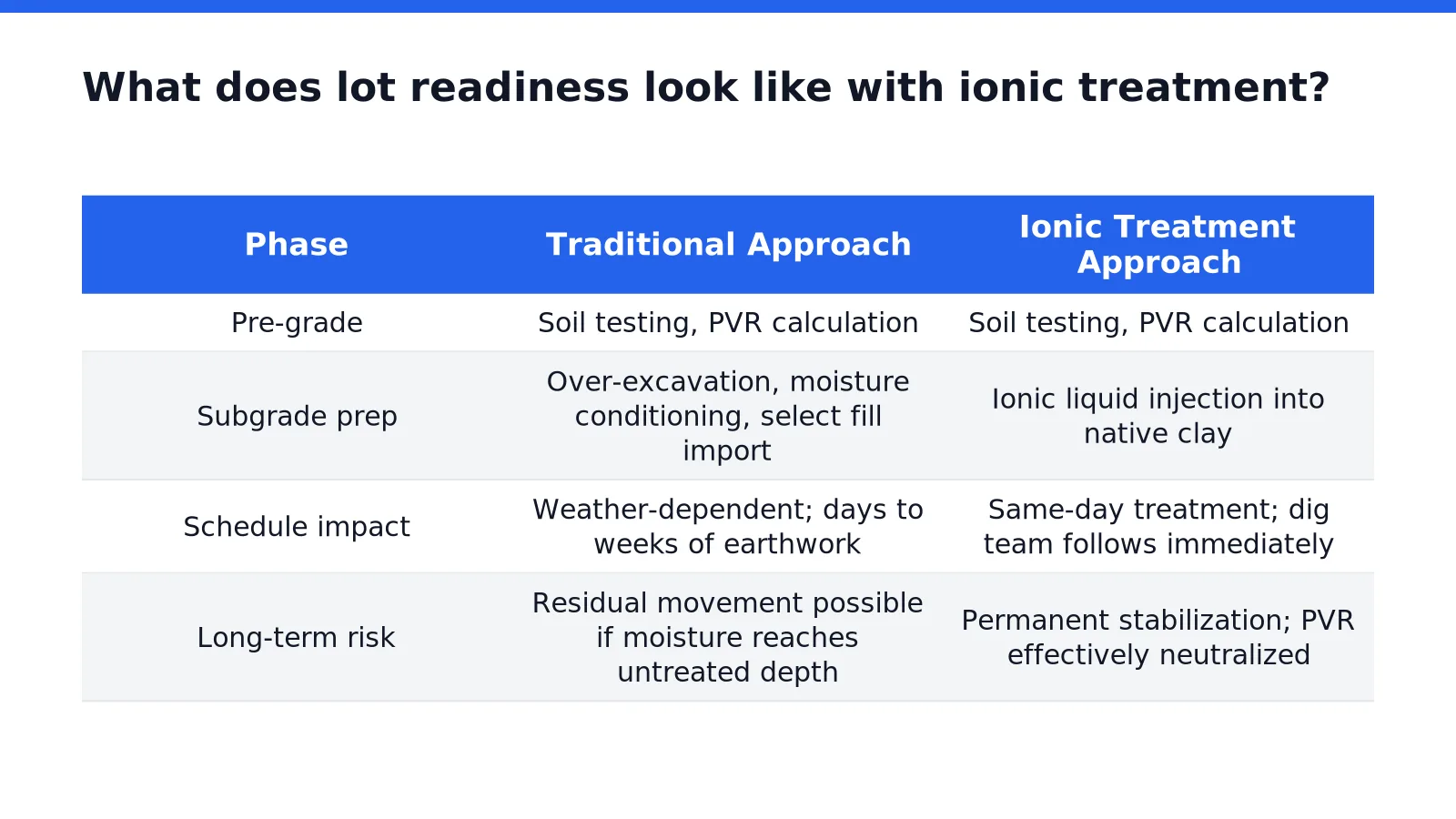
Lot readiness with ionic treatment means a chemically stabilized building pad delivered before excavation begins. TX ProChem crews arrive on site, inject the proprietary ionic liquid stabilizer into the designated footprint, and clear out before the dig team mobilizes. No schedule disruption occurs. The treated soil loses its capacity to absorb water and swell, eliminating the root cause of expansive clay movement.
How does the treatment sequence integrate with existing site prep schedules?
The process slots in ahead of excavation without adding downtime. Crews treat the footprint and depart, leaving the ground ready for immediate digging. Developer site prep workflows remain intact because the injection step functions as a pre-grade activity rather than a separate construction phase. For subdivision-scale projects, the company deploys heavy equipment and full crew capacity to treat entire neighborhoods rapidly. This capacity keeps lot readiness solutions on pace with aggressive plat delivery timelines.
What happens to Potential Vertical Rise after ionic injection?
Soil stabilization for developers targets Potential Vertical Rise (PVR) directly. The ionic liquid alters clay particle polarity at the molecular level, permanently suppressing the shrink-swell cycle. TX ProChem serves developers, builders, and homeowners by reducing PVR risks and keeping project schedules uninterrupted. The result is a subgrade that stays dimensionally stable regardless of seasonal moisture swings. Engineers and project managers gain predictable bearing conditions without over-excavation or select fill replacement.
For individual lots within a larger plat, the hand-injection method secures clay deep underground without disturbing adjacent landscaping or hardscaping. The approach scales cleanly from single custom homes to full commercial soil stabilization programs. ProChem for subdivisions delivers treated pads that reduce construction delays by removing the most common geotechnical surprise in Texas clay country: a foundation excavation that reveals moisture-swollen soil the day after a rain.
How to choose the right soil treatment for your site?
Selecting the correct soil treatment hinges on three factors: soil composition, project scale, and long-term performance requirements. The right choice prevents foundation failures before they begin.
What should developers evaluate before committing to a treatment?
Developers need a clear picture of the expansive clay’s behavior on the specific parcel. Soil stabilization for developers starts with understanding how moisture cycles affect the subgrade. The treatment must neutralize that behavior permanently, not just mask symptoms for one season.
Lot readiness solutions demand a process that integrates with existing construction schedules. A scalable approach matters when crews must treat dozens of lots per week. The Eco-Soil Process offers a scalable method for subgrade stabilization that neutralizes expansive clay before it affects future construction.
How does experience factor into the decision?
A provider’s track record across multiple states signals reliability under varied soil conditions. TX ProChem operates as a family-owned company with more than 30 years of hands-on experience across Texas, Louisiana, Mississippi, Arizona, and Oklahoma. That regional depth matters when soil behavior shifts from county to county.
Developer site prep requires a partner who understands both the science and the logistics. The company is fully insured, fully licensed, and backed by three decades of results. Every proposal is accurate, transparent, and built around the client’s actual budget and timeline.
ProChem for subdivisions means treatment capacity that keeps pace with build-out schedules. Developers who skip this evaluation risk construction delays when unstable lots fail inspection. The right treatment eliminates that risk before excavation begins. For a deeper look at the company’s approach, why ProChem works explains the data-driven process behind permanent stabilization.
Can post-construction soil treatment prevent future damage?
Post-construction soil treatment stops future foundation damage by permanently altering expansive clay at the molecular level. TX ProChem delivers this result through a targeted injection process that addresses the root cause of soil movement rather than masking symptoms. Developers and property managers who skip this step risk structural cracking, schedule disruptions, and costly remediation when moisture cycles reactivate unstable ground.
The treatment works on existing structures without excavation or demolition. Crews inject the ionic liquid stabilizer directly into the clay beneath slabs, footings, and pavement. The solution spreads through the soil profile and changes the electrochemical charge of clay particles. Once treated, the soil loses its capacity to absorb water and swell. This permanent stabilization keeps the ground consistent regardless of drought or heavy rainfall.
How does post-construction treatment differ from pre-construction stabilization?
The chemical mechanism remains identical. Both applications use the same ionic liquid technology to neutralize expansive clay. The difference lies in access and injection angles. Post-construction work requires drilling small access points through existing slabs or working from the perimeter. Pre-construction treatment allows open-surface application with heavy equipment. TX ProChem adapts its delivery method to the site conditions while achieving the same molecular transformation.
What types of projects benefit from treating soil after construction?
Commercial buildings, residential subdivisions, and pool installations all gain protection from post-construction treatment. A luxury pool surrounded by untreated expansive clay faces shell cracking within a single wet-dry season. Warehouse floors over shifting subgrade develop uneven surfaces that disrupt operations. The University of Texas at Arlington study confirmed the ProChemical Soil Stabilizer effectively alters clay soil polarity, validating its versatile stabilization capabilities across these varied applications. Lot readiness solutions extend beyond the initial build phase. Treating soil after construction preserves asset value and eliminates the liability of future ground movement. For developers managing multiple properties, this approach provides a post-construction soil remediation option that fits retrofit timelines and protects completed structures from the hidden threat beneath them.
Conclusion
For developers evaluating soil treatment solutions, the decision reduces to one question: does the approach permanently neutralize expansive clay or simply manage its symptoms? The ionic liquid technology validated by the University of Texas at Arlington study delivers permanent molecular-level stabilization, eliminating PVR risk and the construction delays that follow unstable subgrade. Choosing this method means building on ground that stays dimensionally stable regardless of weather, protecting both project schedules and long-term asset value.