
Independent geotechnical testing validates soil stabilization results after injection, preventing costly foundation failures from expansive clay. TX ProChem Soil Stabilization, with over 30 years of experience, employs patented ProChem Ionic Liquid Stabilizer technology to permanently neutralize shifting clay soil. Post-injection testing protects commercial developments, residential subdivisions, and pool installations across Texas, Louisiana, Mississippi, Arizona, and Oklahoma.
Why Is Independent Geotechnical Testing Critical?
Independent geotechnical testing verifies that soil stabilization treatments actually work. Without post-injection testing, developers and engineers accept invisible subsurface risk that can surface as structural failure years later. Geotech validation provides the only objective proof that expansive clay has been permanently neutralized.
Shifting clay soil causes more damage to Texas homes and buildings than floods, tornadoes, and earthquakes combined. TX ProChem stops this threat at the molecular level, but verification separates a treated site from an untreated gamble. Third-party soil tests eliminate confirmation bias. An independent lab has no stake in the result, so the data speaks plainly.
What does soil testing after injection actually measure?
Soil testing after injection measures changes in the clay’s physical and mechanical properties. Geotechnical testing assesses these properties to evaluate suitability for construction, mitigating risks such as structural failure and settlement. The tests confirm whether the soil can still absorb water and swell, or whether the ionic treatment has permanently altered that behavior.
How does verification protect project timelines and budgets?
Prochem treatment verification catches problems before concrete pours. The strength and longevity of any paved surface depend on the quality of the base and subgrade below the pavement. A failed subgrade discovered after construction triggers costly tear-outs and schedule delays. Independent testing confirms stability upfront, keeping projects on track.
TX ProChem brings more than 30 years of hands-on experience across Texas, Louisiana, Mississippi, Arizona, and Oklahoma. The company’s engineers and partners receive detailed geotechnical reports that document pre-treatment conditions and post-injection results. This documentation creates a permanent record that protects every stakeholder, from the developer financing the project to the structural engineer stamping the plans.
What Tests Validate Soil Stabilization Effectiveness?
Validating soil stabilization requires a combination of laboratory analysis and field verification. The most critical metric is a measurable reduction in the Plasticity Index (PI) of treated clay soils. A two-year study conducted by the University of Texas at Arlington confirmed that TX ProChem’s ionic liquid stabilizer reduces the PI of expansive soil, directly quantifying the treatment’s success.
How Does a Plasticity Index Test Confirm Stabilization?
The Plasticity Index measures the moisture range where soil behaves plastically. Expansive clays have high PI values, causing destructive shrink-swell cycles. A lower PI after treatment proves the soil has lost its capacity to absorb water and change volume. This single data point tells engineers the stabilization is permanent.
What Role Does Electron Microscopy Play in Verification?
Visual confirmation at the molecular level provides undeniable proof of chemical change. The University of Texas at Arlington study verified, through electron microscopy, that the product changed the polarity of clay soils by removing their negative charge. This geotech validation step confirms the physical mechanism behind the PI reduction, leaving no doubt about the treatment’s effectiveness.
Post-injection testing protocols combine these methods. A thorough assessment of subsurface conditions and application of sound geotechnical engineering principles provide clients practical and cost-effective solutions. The process typically follows a clear sequence:
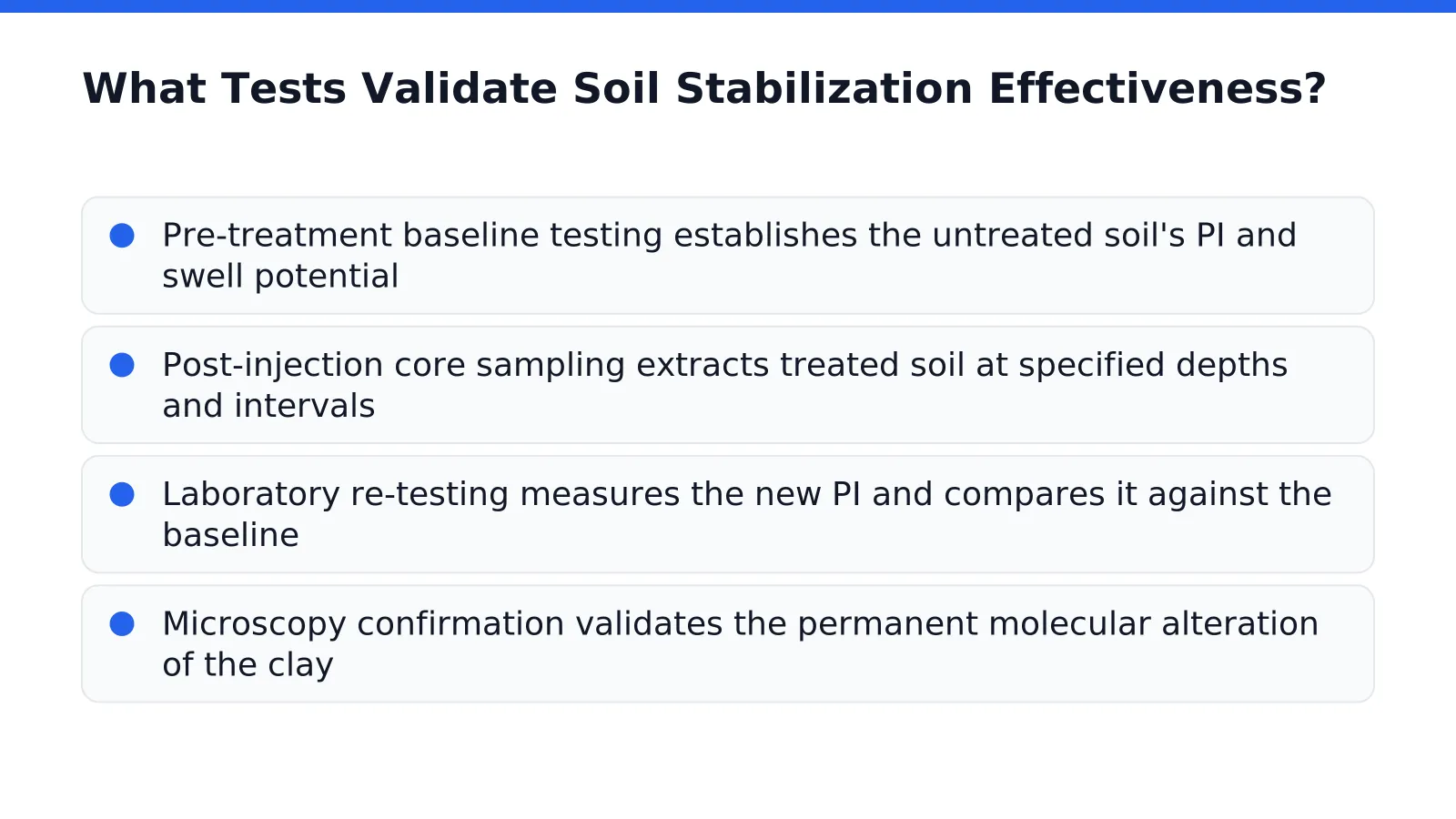
- Pre-treatment baseline testing establishes the untreated soil’s PI and swell potential
- Post-injection core sampling extracts treated soil at specified depths and intervals
- Laboratory re-testing measures the new PI and compares it against the baseline
- Microscopy confirmation validates the permanent molecular alteration of the clay
Why Are Third-Party Soil Tests Essential for Project Closeout?
Independent verification removes any conflict of interest from the quality assurance process. Developers and structural engineers rely on third-party soil tests to certify that the prochem treatment verification meets project specifications. These unbiased reports become permanent documentation for warranty files and future property transactions. The University of Texas at Arlington study provides the scientific foundation that makes this verification protocol reliable and repeatable across every project site.
How Does Post-Injection Testing Verify Treatment Success?
Post-injection testing confirms that chemical soil stabilization meets design objectives. Verification testing during construction guides confirmation that the treated ground performs as engineered, according to the Appendix B Soil Stabilization Testing Manual.
Without this validation step, developers and engineers carry undetected risk. Expansive clay that appears stable after treatment may still retain moisture sensitivity at depth. A single missed zone compromises the entire foundation system.
What Does Post-Injection Testing Measure?
The testing protocol examines specific soil properties that indicate successful molecular alteration. Proper sampling and storage procedures are critical to obtain high quality results for subgrade stabilization projects. The Appendix B Soil Stabilization Testing Manual emphasizes that proper sampling provides results representative of the actual soil conditions.
Key measurements include:
- Moisture content before and after treatment to confirm reduced water affinity
- Plasticity index changes showing the clay has lost its expansive behavior
- pH and conductivity readings verifying ionic liquid distribution throughout the treatment zone
- Strength parameters demonstrating consistent bearing capacity across the site
How Do Third-Party Soil Tests Strengthen Project Confidence?
Independent third-party soil tests remove any conflict of interest from the verification process. A qualified geotechnical laboratory analyzes samples collected after injection and compares them against baseline data from the pre-treatment survey.
TX ProChem treats up to 6,000 square feet per day per tractor, making large-scale verification practical. The company’s permanent stabilization approach keeps ground consistent irrespective of weather conditions. Geotech validation through an accredited lab confirms this consistency with documented results that structural engineers and building officials accept without delay.
Prochem treatment verification follows a straightforward sequence. Technicians extract core samples from multiple depths across the treated area. The laboratory runs standardized ASTM and AASHTO procedures on each sample. Results arrive as a stamped report showing the soil now classifies as non-expansive.
What Happens When Post-Injection Results Fall Short?
Retesting identifies the specific zone requiring additional treatment. The ionic liquid application targets only the under-treated area rather than re-treating the entire site. This precision keeps projects on schedule while ensuring every square foot meets the stabilization specification.
What Role Do Third-Party Soil Tests Play?
Independent laboratory analysis provides the definitive measure of soil stabilization success. Third-party soil tests deliver unbiased data that confirms whether expansive clay has been permanently altered at the molecular level. Without this verification, developers and engineers carry invisible risk beneath every slab and pavement section.
Why Is Independent Verification Necessary After Injection?
TX ProChem addresses the root cause of foundation damage by injecting its ionic liquid stabilizer directly into expansive clay. The treatment permanently changes how the soil responds to moisture. But chemical alteration happens underground, invisible to the naked eye. Independent testing extracts core samples and subjects them to standardized procedures that measure swelling potential, moisture susceptibility, and bearing capacity. The numbers either confirm stabilization or they do not. There is no middle ground.
What Does the Post-Injection Testing Process Involve?
Expert soil testing is the critical first step to ensuring a project’s success. After treatment, a licensed geotechnical firm collects samples from treated zones and runs a battery of ASTM-standard analyzes. These soil testing after injection protocols typically include:
- Atterberg limits testing to measure plasticity changes
- Swell testing to quantify volume change under saturation
- pH and chemical analysis to verify stabilizer distribution
- Compressive strength testing for load-bearing validation
The resulting report becomes the permanent record of subsurface performance. Early discovery of subsurface conditions avoids costly unknowns. Developers who skip this step risk discovering untreated pockets only after concrete cracks and warranty claims begin.
How Does Geotech Validation Protect Project Budgets?
Prochem treatment verification through a qualified geotechnical engineer transforms soil stabilization from a contractor’s promise into a documented asset. TX ProChem offers transparent proposals crafted to fit customer budgets and timelines. The geotech validation report closes the loop, giving structural engineers the data they need to sign off on foundation designs. Projects move forward with certainty. Liability shifts from guesswork to documented fact.
How Can You Secure Permanent Soil Stability?
Permanent soil stability requires altering expansive clay at the molecular level. TX ProChem achieves this through a proprietary ionic liquid treatment that locks soil in place permanently, preventing the destructive cycle of swelling and shrinking.
The company brings commercial-grade soil science directly to residential builds. This approach neutralizes expansive clay permanently rather than merely managing its symptoms. For developers and contractors, the result is a substrate that remains consistent regardless of drought or heavy rainfall.
Post-injection testing confirms that treated soil loses its capacity to absorb excess water. The ionic stabilizer changes the polarity of clay particles, rendering them physically incapable of the expansion that cracks foundations and pool shells. Independent third-party soil tests provide objective verification of this transformation.
What Does the Treatment Process Involve?
TX ProChem crews arrive before excavation begins. They treat the designated footprint and leave the site ready for the dig team with zero delays. The process integrates directly alongside existing build sequences without disrupting project timelines.
How Is Treatment Effectiveness Verified?
Geotech validation follows every application. Engineers conduct soil testing after injection to measure moisture susceptibility and bearing capacity. This prochem treatment verification step ensures the stabilized ground meets structural requirements before construction proceeds.
The company operates with 50 employees, providing the crew capacity to handle large-scale commercial and residential projects simultaneously. Fully insured, fully licensed, and backed by three decades of results, TX ProChem delivers soil stabilization services that eliminate underground movement as a construction variable.
Conclusion
Independent geotechnical testing removes uncertainty from soil stabilization, delivering documented proof that expansive clay no longer threatens the structure above it. Developers and engineers who commission third-party verification after injection secure a permanent record of subsurface performance, allowing foundation designs to proceed with confidence and eliminating the invisible risk that untreated soil carries.