
Commercial soil stabilization on construction sites neutralizes expansive clay at the molecular level before building begins. TX ProChem’s patented ionic liquid stabilizer, validated by the University of Texas at Arlington, prevents settlement and cracking. The process treats up to 6,000 square feet daily, protecting warehouses, offices, and retail centers from costly structural damage.
Why does expansive clay threaten commercial foundations?
Expansive clay soils cause more structural damage in Texas than floods, tornadoes, and earthquakes combined. A single season of heavy rain or extreme drought shifts the earth enough to crack a commercial slab.
The threat lies in the clay’s molecular behavior. High-plasticity clays swell dramatically when wet and shrink when dry. This cycle never stops. It repeats with every weather change, exerting immense pressure against foundations, slabs, and underground utilities. Building directly on these materials without treatment risks foundation settlement, pavement failure, and structural distress, according to industry analysis from USA Nova’s 2026 soil stabilization guide.
How does moisture fluctuation damage a commercial slab?
Moisture changes create differential movement across a building’s footprint. One section of soil expands while another remains stable. The resulting stress fractures concrete and warps steel reinforcement. Expansive clay and swimming pools are a dangerous mix, and the same principle applies to large commercial structures with broad, rigid foundations. A warehouse floor or office complex slab faces identical forces.
What makes Texas clay uniquely destructive?
Texas contains some of the most volatile high-plasticity CH clays in the country. These soils can absorb water up to 20 times their dry volume. The shrink-swell potential creates a perpetual threat that standard compaction cannot resolve. TX ProChem addresses this at the molecular level through pre-construction soil treatment, altering the clay’s polarity so it permanently loses the ability to absorb excess water. This approach directly targets the root cause of foundation failure in expansive soils.
For developers and civil engineers, the financial stakes are immediate. Untreated expansive clay leads to cracked slabs, misaligned door frames, and failed pavement within the first few years of occupancy. The company’s commercial soil stabilization process eliminates this liability before concrete is poured, keeping project schedules intact and long-term maintenance costs off the balance sheet.
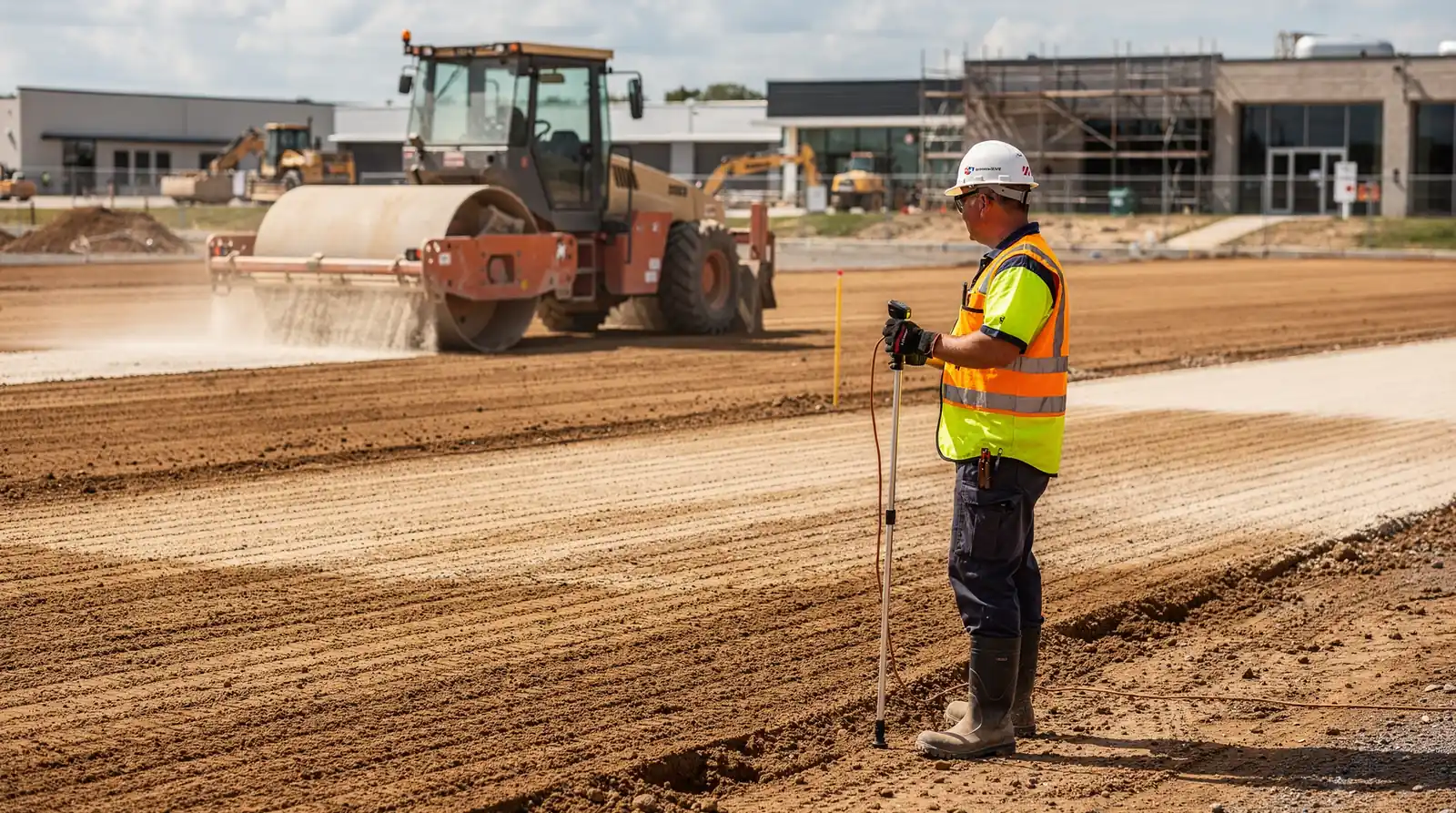
What is commercial soil stabilization exactly?
Commercial soil stabilization is the engineering process of improving weak or problematic soils to make them suitable for construction. Without it, expansive clay soils swell and shrink with moisture changes, creating foundation movement that threatens structural integrity.
The process transforms unreliable ground into a stable building platform. For commercial developers and civil engineers, this means eliminating the root cause of settlement before concrete is poured. TX ProChem approaches this challenge at the molecular level. The company pioneered the ProChem Ionic Liquid Stabilizer, a patented solution validated through a two-year study conducted by the University of Texas at Arlington.
How does ionic soil stabilization work differently from traditional methods?
Traditional approaches involve removing bad soil and replacing it. Those methods remove bad soil and replace it. Ionic stabilization changes the soil itself.
The University of Texas at Arlington study found that the product effectively changed the polarity of clay soils by removing their negative charge, a conclusion verified through electron microscopy. This permanent alteration prevents water absorption. The soil stops swelling. It stops shrinking. The ground remains consistent regardless of drought or heavy rainfall.
What measurable results does chemical soil treatment deliver?
Engineers and project managers need quantifiable outcomes. The research provides them. The liquid ionic soil stabilizer was found to reduce the Plasticity Index of treated soils. A lower Plasticity Index means less volume change as moisture fluctuates.
TX ProChem applies this technology through large site soil injection, treating up to 6,000 square feet per day per tractor. The process integrates directly into existing construction schedules. Developers pursuing pre-construction soil treatment avoid the delays and costs associated with removing thousands of yards of unstable material. Site stabilization for developers becomes a scheduled line item rather than a crisis response.
For projects requiring reduce PVR commercial strategies, the ionic approach addresses Potential Vertical Rise at its source. The treated soil loses its capacity to heave, protecting slab foundations, pavement sections, and underground utilities from the differential movement that causes structural cracking. Commercial soil stabilization services apply this science across warehouse sites, retail centers, and manufacturing facilities where foundation performance specifications leave no room for soil-related failures.
How does pre-construction soil treatment work?
Pre-construction soil treatment permanently alters expansive clay at the molecular level. TX ProChem injects a proprietary ionic liquid stabilizer directly into the ground, eliminating the soil’s ability to swell and shrink with moisture changes.
The process targets the root cause of foundation failure. Expansive clay soils absorb water during wet seasons and contract during droughts. This cycle exerts tremendous pressure on slabs, footings, and pavement. Without intervention, the movement causes structural cracking and costly remediation.
What happens to the soil during ionic stabilization?
TX ProChem’s treatment alters the polarity of the clay particles. The ionic liquid renders the soil physically incapable of absorbing excess water. Once treated, the ground maintains consistent volume regardless of weather conditions. The company employs a permanent stabilization approach that does not degrade or wash out over time.
How quickly can a commercial site be treated?
Speed matters on construction schedules. TX ProChem’s equipment handles up to 6,000 square feet per day per tractor. This large site soil injection capacity keeps earthwork and foundation phases on track. The treatment integrates directly into the grading schedule, treating pads before concrete placement begins.
The method suits a wide range of commercial applications. Warehouses, retail centers, and manufacturing facilities all benefit from pre-construction soil treatment that neutralizes expansive clay before loads are applied. For developers, the primary advantage is certainty. Site stabilization for developers removes the variable of post-construction ground movement from project risk calculations.
Commercial soil stabilization through ionic injection also addresses reduce pvr commercial requirements directly. Potential Vertical Rise (PVR) values drop after treatment, helping projects meet geotechnical specifications without over-excavation or imported fill. The result is a stable building pad that performs consistently for decades.
TX ProChem’s soil stabilization services integrate with standard sitework sequencing. Treatment occurs after rough grading but before utilities and slab work. This timing prevents schedule disruption while delivering a permanently stable subgrade.
Can site stabilization for developers reduce PVR?
Site stabilization for developers directly reduces Potential Vertical Rise (PVR) by altering expansive clay at the molecular level. TX ProChem’s ionic liquid treatment stops the endless cycle of swelling and shrinking for good, eliminating the primary driver of PVR calculations.
PVR measures how much soil will heave upward as moisture content changes. High PVR values threaten slab foundations, pavement sections, and underground utilities. Developers who ignore these risks face warranty claims, structural distress, and reputational damage that compounds across an entire subdivision.
TX ProChem serves developers, builders, and homeowners by reducing risks associated with Potential Vertical Rise. The company deploys heavy equipment and crew capacity to rapidly treat entire neighborhoods before slabs are poured. This pre-construction soil treatment approach locks soil behavior in place permanently. Moisture fluctuations no longer translate into vertical movement.
How does molecular soil treatment lower PVR values?
The treatment changes soil particle polarity. Treated clay cannot absorb excess water. Without that absorption, the swell potential driving PVR calculations drops to negligible levels. Geotechnical engineers can then certify lower PVR values, which satisfies lender requirements and structural performance specifications.
What happens when developers skip pre-construction soil treatment?
Addressing soil conditions before construction begins helps create a stronger, more reliable base for everything that follows. Skipping this step leaves expansive clay active beneath foundations. Seasonal moisture cycles trigger differential movement. Slabs crack. Utilities shift. Repair costs multiply across multiple lots rather than a single structure.
Large site soil injection makes treatment feasible at subdivision scale. TX ProChem’s equipment treats up to 6,000 square feet per day per tractor. The process integrates directly into existing build sequences without delaying pad preparation or utility rough-in. Developers hand over keys without worrying about underground movement ruining their reputation.
Commercial soil stabilization through ionic injection provides a permanent solution rather than a temporary moisture barrier. Traditional methods like over-excavation or lime treatment add days to schedules and variable results to PVR outcomes. The ionic approach delivers consistent, verifiable reduction in swell potential across every treated lot.
What are the signs a site needs stabilization?
Weak, wet, or poorly compacting soils signal trouble long before construction begins. These conditions undermine earthwork production and threaten the long-term performance of roads and pavement. A site that cannot support heavy equipment without rutting or pumping indicates inadequate bearing capacity. Project managers who ignore these early warnings face schedule delays and structural failures that multiply costs across every subsequent phase.
How does poor soil affect construction schedules?
Unstable ground halts progress. When soils fail to compact properly, crews lose productive days waiting for conditions to improve. Addressing soil problems early gives project teams more options before utilities, paving, and other phases become compromised. The alternative, removing large quantities of unsuitable material and importing replacement fill, drains budgets and extends timelines unnecessarily.
What makes expansive clay particularly dangerous?
Expansive clay swells when wet and shrinks during drought. This cycle exerts tremendous pressure on foundations, slabs, and underground utilities. Pre-construction soil treatment with ionic stabilization alters clay at the molecular level, permanently neutralizing its water-absorbing capacity. TX ProChem’s ProChem Ionic Liquid Stabilizer locks the soil in place, eliminating the shrink-swell cycle that causes structural distress.
Commercial soil stabilization becomes essential when soil reports reveal high plasticity indices or when preliminary grading exposes soft, inconsistent material. Site stabilization for developers transforms problematic parcels into buildable ground without the expense of over-excavation. Every construction project depends on what lies beneath it. The soil must provide a stable surface capable of supporting construction activity from the first day of earthwork through decades of service.
How does large site soil injection compare to excavation?
Large site soil injection treats expansive clay in place without removing a single cubic yard of material. A single tractor treats up to 6,000 square feet per day, delivering permanent stabilization that excavation and replacement cannot match for speed or cost.
Excavation removes unstable soil and replaces it with engineered fill. Traditional methods involve removing unstable material. Injection eliminates all of that. TX ProChem crews arrive before foundation work begins, treat the designated footprint, and leave the site ready for the concrete team with zero delays and complete stability.
What makes injection faster than traditional excavation?
Speed comes from the equipment and the chemistry. One tractor covers 6,000 square feet daily. Excavation spreads the same area across days of cutting, hauling, and compacting lifts. Injection keeps the project schedule intact because no material leaves the site, leaving the pad completely stable and ready for foundation work.
Does injection provide the same long-term stability as removal?
Injection delivers permanent results. The ionic liquid treatment alters expansive clay at the molecular level, keeping the ground consistent regardless of weather conditions. Excavation replaces the problem soil but does nothing to address moisture migration into adjacent untreated areas. Injection treats the soil in place and locks it permanently.
For developers managing tight timelines, site stabilization for developers through injection removes the logistical burden of soil disposal. Pre-construction soil treatment with ionic injection also helps reduce PVR commercial projects face when expansive clays lie beneath slab foundations. A recent amenity center project in Fort Worth demonstrated the approach at scale: crews treated 27,000 square feet of expansive clay in ten days using ionic chemical injection technology.
Why do engineers choose injection for expansive clay sites?
Injecting the stabilizer directly into expansive clay soil addresses the root cause of foundation issues. Expansive clay swells when it absorbs water and shrinks when it dries. Excavation removes the clay but leaves the moisture cycle intact in surrounding soils. Injection neutralizes the clay’s ability to absorb water entirely. The treated soil becomes inert to moisture changes, eliminating the shrink-swell cycle that damages slabs and pavements.
Commercial soil stabilization through large site soil injection also preserves site access. Excavation turns the building pad into a mud pit after rain. Injection leaves the surface firm and workable. Contractors move directly into foundation work without waiting for the subgrade to dry or re-compacting disturbed areas.
Why choose a patented ionic liquid stabilizer?
TX ProChem pioneered the ProChem Ionic Liquid Stabilizer, a patented solution validated through a two-year study conducted by the University of Texas at Arlington. The study confirmed the product changes clay soil polarity by removing its negative charge, a finding verified through electron microscopy. Commercial developers who skip this treatment risk foundation settlement and structural distress that surface only after construction is complete.
The company’s approach addresses expansive clay at the molecular level rather than masking symptoms. A University of Texas at Arlington study documented a measurable reduction in the Plasticity Index of treated soils. Lower plasticity means the soil resists the swelling and shrinking cycle that damages slabs, pavements, and buried utilities.
What does the University of Texas at Arlington study prove?
The two-year study found the liquid ionic soil stabilizer reduced the Plasticity Index of expansive soil. Electron microscopy verified the polarity change at the particle level. This evidence gives engineers and project managers documented performance data instead of marketing claims.
Why does 30 years of field experience matter for commercial projects?
TX ProChem operates as a family-owned soil stabilization company with more than 30 years of hands-on experience across Texas, Louisiana, Mississippi, Arizona, and Oklahoma. That regional depth means crews understand how local clay behaves under drought and flood cycles. Developers gain a partner who has treated the same soil conditions that threaten their current sites.
The patented chemistry, independent validation, and three decades of field application combine into one outcome: a foundation that stays stable regardless of weather.
How do you get started with TX ProChem?
Getting started with TX ProChem begins with a transparent proposal built around the client’s actual budget and timeline. Every proposal the company presents is accurate and specific to the project’s soil conditions. Commercial general contractors and civil engineers receive a clear scope of work before any equipment arrives on site.
The company’s client-centered approach distinguishes the process from conventional soil treatment vendors. TX ProChem crafts proposals that fit customer budgets and timelines without hidden contingencies or vague allowances. Project managers gain a definitive cost picture during pre-construction planning, not after mobilization.
What does the initial assessment cover?
The assessment identifies expansive clay zones and quantifies the Potential Vertical Rise risk across the site. TX ProChem evaluates soil composition, moisture patterns, and structural loading requirements. The resulting treatment plan specifies injection depths, grid spacing, and production sequencing.
How does TX ProChem integrate with existing construction schedules?
The workflow integrates smoothly with existing construction plans. Crews coordinate directly with the general contractor’s build sequence. Large site soil injection equipment treats up to 6,000 square feet per day per tractor, keeping earthwork and foundation phases on schedule.
Working with TX ProChem means working with the team that wrote the book on Texas soil stabilization. The company is fully insured, fully licensed, and backed by three decades of results. A high client satisfaction rate reflects the company’s commitment to quality across commercial, residential, and pool construction projects.
Conclusion
For commercial construction sites underlain by expansive clay, the decision to stabilize the soil before pouring concrete eliminates the structural risk that excavation alone leaves in place. Developers who choose injection secure a foundation that resists the shrink-swell cycle permanently, protect their schedule from weather delays, and remove the logistical cost of hauling soil off site. The documented performance data from the University of Texas at Arlington study gives engineers the confidence to specify ionic treatment as the primary solution rather than a secondary measure.