
General contractors use soil stabilization to neutralize expansive clay before foundations are poured, preventing structural damage from shifting ground. TX ProChem’s patented ionic liquid stabilizer alters soil behavior at the molecular level, reducing Potential Vertical Rise (PVR) and keeping project schedules on track without costly redesigns.
Why stabilize soil before pouring foundations?
Expansive clay soil causes more damage to Texas homes and buildings than floods, tornadoes, and earthquakes combined. Soil stabilization neutralizes this threat at the molecular level before concrete ever touches the ground.
Without treatment, moisture fluctuations trigger a destructive cycle. Clay swells when wet and shrinks during drought. This movement transfers enormous pressure to foundation slabs. Cracks form. Doors jam. Walls separate. The repair costs mount quickly. Foundation risk mitigation through pre-construction soil treatment prevents these failures entirely.
How does the gc soil treatment process work before excavation?
The process follows a clear sequence that integrates with existing site preparation schedules.
- Conduct a geotechnical assessment of the site’s clay composition and moisture profile.
- Apply the ionic liquid stabilizer directly to the subgrade using specialized injection equipment.
- Allow the solution to permeate the soil, altering clay particle polarity on a molecular level.
- Verify treatment depth and uniformity before clearing the site for foundation work.
This method permanently changes how clay interacts with water. Treated soil loses its ability to absorb moisture. It remains volumetrically stable regardless of rainfall or drought conditions.
What makes ionic stabilization different from traditional methods?
Traditional approaches like over-excavation or lime treatment address symptoms rather than the root cause. TX ProChem pioneered the ProChem Ionic Liquid Stabilizer, a patented solution validated through a two-year study conducted by the University of Texas at Arlington. The company’s soil stabilization for general contractors delivers a permanent fix rather than a temporary barrier.
The treatment improves load-bearing capacity and eliminates the potential for shrinking or swelling. General contractors gain predictable subgrade conditions that reduce rework caused by weather delays or failed compaction tests. This reliability directly enables construction schedule acceleration, keeping foundation crews moving without interruption.
TX ProChem brings over 30 years of hands-on experience stabilizing soil across Texas and neighboring states. The company’s ionic soil stabilization services treat up to 6,000 square feet per day per tractor, matching the pace of large-scale commercial and residential projects.
What is the gc soil treatment process?
The gc soil treatment process is a chemical injection method that permanently alters expansive clay at the molecular level. TX ProChem applies a proprietary ionic liquid stabilizer directly into the soil, changing its polarity so the clay cannot absorb water. This eliminates the shrink-swell cycle that damages foundations.
The treatment targets the root cause of soil movement rather than managing its symptoms. A University of Texas at Arlington study confirmed the product effectively changes clay soil polarity by removing its negative charge, a conclusion verified through electron microscopy. Without this intervention, expansive clay continues its destructive cycle of swelling after rain and shrinking during drought. That movement transfers stress directly into slabs, footings, and structural elements.
How does the ionic liquid change soil behavior?
The ionic liquid renders clay physically incapable of absorbing excess water. By stripping the negative charge from clay particles, the treatment permanently neutralizes their natural affinity for moisture. The soil becomes inert and dimensionally stable regardless of weather conditions.
What happens on site during treatment?
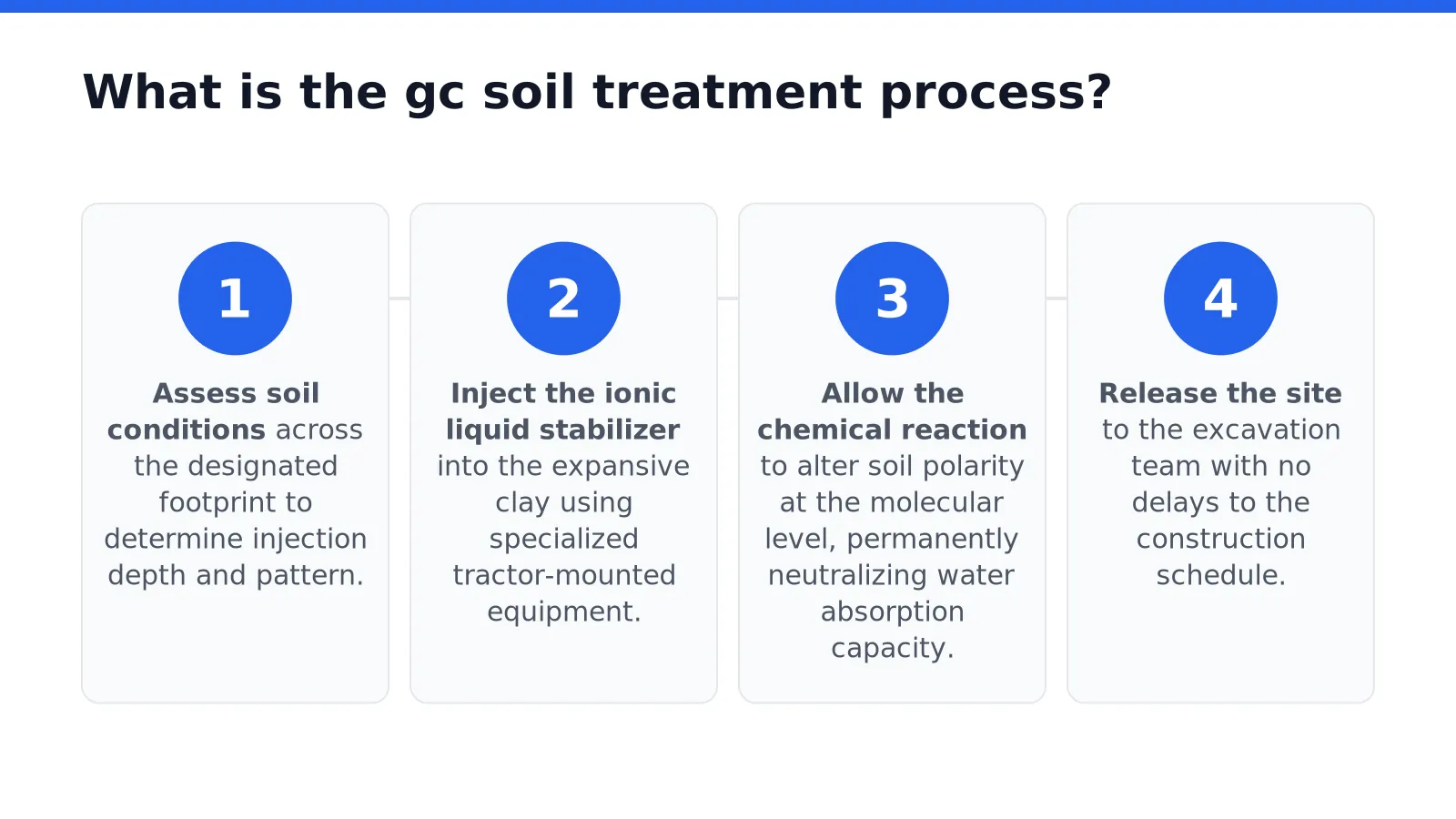
TX ProChem crews arrive before excavation begins. The sequence follows four steps:
- Assess soil conditions across the designated footprint to determine injection depth and pattern.
- Inject the ionic liquid stabilizer into the expansive clay using specialized tractor-mounted equipment.
- Allow the chemical reaction to alter soil polarity at the molecular level, permanently neutralizing water absorption capacity.
- Release the site to the excavation team with no delays to the construction schedule.
The company treats up to 6,000 square feet per day per tractor. This capacity supports construction schedule acceleration on large-scale commercial and residential projects. The process integrates directly with existing build sequences. Crews treat the footprint, then leave the site ready for digging. Zero delays occur.
This approach delivers foundation risk mitigation that traditional over-excavation and replacement cannot match. General contractors eliminate the uncertainty of expansive soils before concrete is poured. The result is a stable subgrade that does not move, crack, or heave, which directly helps reduce rework caused by post-construction soil movement. The University of Texas at Arlington study documented significant reductions in soil plasticity index and swell potential, confirming the treatment’s effectiveness for soil stabilization for general contractors managing builds on Texas clay.
How does stabilization reduce rework?
Soil stabilization reduces rework by eliminating the root cause of foundation movement before construction begins. General contractors who treat expansive clay at the molecular level avoid the costly cycle of repair, re-excavation, and structural correction that follows seasonal soil shifts.
Shifting clay soil does more damage to Texas homes than floods and storms combined. Foundation cracks appear when untreated soil swells after rain and shrinks during drought. Those cracks trigger structural repairs that drain project budgets and delay closeout. Soil stabilization for general contractors interrupts this failure chain at its source.
What causes the rework cycle on expansive clay?
The rework cycle starts with moisture. Expansive clay absorbs water, swells, and lifts slabs. Then drought pulls moisture out, the clay shrinks, and the slab drops. This heave-and-settle pattern repeats every season. The gc soil treatment process stops the cycle by altering clay polarity at the molecular level. Treated soil becomes physically incapable of absorbing excess water.
The permanent stabilization approach keeps the ground consistent irrespective of weather conditions. No seasonal heave means no post-construction settlement. No settlement means no callbacks for cracked drywall, sticking doors, or uneven floors.
How does treatment prevent warranty callbacks?
Warranty callbacks represent the most expensive form of rework. A builder hands over keys, then returns months later to repair foundation damage. For developers, treating entire neighborhoods prevents underground movement from ruining reputation and triggering warranty callbacks. TX ProChem brings heavy equipment and crew capacity to treat entire subdivisions before vertical construction begins.
The ionic liquid stabilizer reduces the plasticity index of expansive soil, as demonstrated in the University of Texas at Arlington study. Lower plasticity means the clay behaves less like a sponge and more like stable subgrade. Contractors who apply this treatment on private industrial development projects eliminate the underground movement that forces rework after occupancy.
Foundation risk mitigation through pre-construction treatment delivers measurable construction schedule acceleration. Crews pour slabs on stable ground the first time. No re-excavation. No structural retrofits. No punch-list repairs tied to soil movement. The project closes on schedule, and the contractor protects both margin and reputation.
Can stabilization accelerate construction schedules?
Soil stabilization directly accelerates construction schedules by eliminating the delays caused by expansive clay soils. Construction schedule acceleration becomes possible when unstable subgrades are treated before grading begins, preventing the redesigns and settlement issues that derail project timelines.
How does the soil treatment process fit into a general contractor’s workflow?
The gc soil treatment process integrates seamlessly into existing build sequences. Crews arrive before excavation, treat the designated footprint, and leave the site ready for the dig team with zero delays. This pre-excavation timing ensures that foundation work proceeds without interruption.
What daily production rates can contractors expect?
TX ProChem’s equipment handles up to 6,000 square feet per day per tractor. This large-scale treatment capacity keeps pace with aggressive construction schedules. Subdivision developers and commercial builders avoid the bottleneck that slower, traditional methods create.
The sequence for integrating stabilization follows a clear order:
- Evaluate soil conditions and secure a transparent proposal built around the project’s actual budget and timeline.
- Schedule the treatment crew to arrive before grading operations begin.
- Allow the crew to treat the full building footprint, altering the clay at a molecular level.
- Proceed with excavation and foundation work on the now-stable subgrade.
This approach delivers foundation risk mitigation by neutralizing the soil’s capacity to swell or shrink. General contractors reduce rework because foundations remain stable through wet and dry cycles. The company’s proprietary ionic liquid stabilizer locks the soil in place permanently.
For soil stabilization for general contractors, the schedule benefit is measurable. A treated site moves from grading to foundation pour without the weather-related stops that plague expansive clay projects. The molecular change is irreversible. The construction timeline stays intact.
What foundation risk mitigation does stabilization provide?
Foundation risk mitigation through soil stabilization eliminates the root cause of structural damage. TX ProChem injects a proprietary ionic liquid stabilizer directly into expansive clay soil, permanently altering its molecular behavior.
The process prevents the endless cycle of swelling and shrinking that destroys foundations. General contractors gain a predictable, stable subgrade from day one of site prep through years after project completion.
How does molecular stabilization prevent foundation failure?
Expansive clay absorbs water and expands, then contracts during drought. This movement generates enough force to crack concrete slabs and shift structural elements.
TX ProChem’s foundation risk mitigation approach changes the soil’s polarity at a molecular level. The treated ground becomes physically incapable of absorbing excess moisture. No moisture absorption means no swelling. No swelling means no movement. The foundation remains undisturbed regardless of weather conditions.
What makes this approach different from traditional methods?
Traditional methods address symptoms after damage occurs. Excavation and replacement, pier installation, and moisture barriers treat the consequences of soil movement rather than its cause.
The gc soil treatment process from TX ProChem targets the source. The ionic liquid stabilizer penetrates the clay formation and permanently locks the soil structure. This single application provides lasting stability without ongoing maintenance or seasonal adjustments.
The company carries full insurance and licensing credentials, backed by three decades of documented results across Texas and neighboring states. Contractors who incorporate this treatment into pre-construction workflows reduce rework caused by post-build foundation issues. Project timelines stay intact when the ground beneath the structure remains consistent.
Construction schedule acceleration becomes possible because crews work on stable subgrade from the start. No delays from unexpected soil conditions. No callbacks for foundation repairs after handover. The stabilization integrates directly into existing build sequences, treating up to 6,000 square feet per day per tractor.
Conclusion
General contractors who integrate soil stabilization into pre-construction workflows eliminate the root cause of foundation failure and the warranty callbacks that follow. The decision to treat expansive clay before grading begins locks in a stable subgrade, accelerates the construction schedule, and protects both margin and reputation through every season.