
Soil stabilization cost varies by project size, but TX ProChem’s permanent molecular treatment prevents catastrophic foundation cracking from expansive clay. The company has delivered commercial-grade fixes that reduce trucking, construction time, and pavement thickness. Clients gain lifetime structural ROI by eliminating costly post-construction repairs.
What drives soil stabilization costs?
Soil stabilization costs hinge on project scale, site complexity, and the severity of the expansive clay threat. Shifting clay soil does more damage to Texas homes than floods and storms combined, making accurate cost assessment a critical first step for developers and property owners.
How does project size affect the price?
Larger sites demand more material, equipment hours, and crew deployment. The cost per square foot stabilization often decreases as total square footage increases because mobilization and setup expenses spread across a broader area. A single residential lot carries a different cost structure than a 200-lot subdivision. TX ProChem treats up to 6,000 square feet per day per tractor, a production rate that directly shapes the economics of any commercial or residential project.
Why do urban sites cost more than rural ones?
Urban work introduces obstacles absent from open-field projects. Manholes, catch basins, and intersection control add complexity and time. Crews must navigate underground utilities, maintain precise injection patterns around existing infrastructure, and coordinate with municipal requirements. Rural sites typically allow uninterrupted equipment movement and faster completion. These logistical differences create a measurable gap in final project pricing.
What role does traffic control play in the budget?
Traffic maintenance requirements influence both direct costs and project duration. A closed local traffic setup keeps crews moving efficiently. Alternate traffic patterns through the project zone require flaggers, signage, and phased work sequences. Each additional day of traffic management adds labor and equipment costs. Developers who plan stabilization during early site preparation, before roads carry regular traffic, avoid these expenses entirely.
Construction ROI soil treatment calculations must weigh these variables against the alternative. Traditional select fill vs injection comparisons reveal that removing and replacing expansive clay generates significant trucking expenses and extends project schedules. Injection methods like TX ProChem’s ionic liquid treatment eliminate excavation and haul-off, delivering permanent molecular stabilization without disrupting the build sequence. Contractors and engineers seeking to reduce stabilization costs should evaluate site access, urban density, and traffic phasing before finalizing a treatment plan. The company’s soil stabilization cost savings become most apparent when these factors align with early intervention, before foundation loads and pavement layers lock problem soils in place.
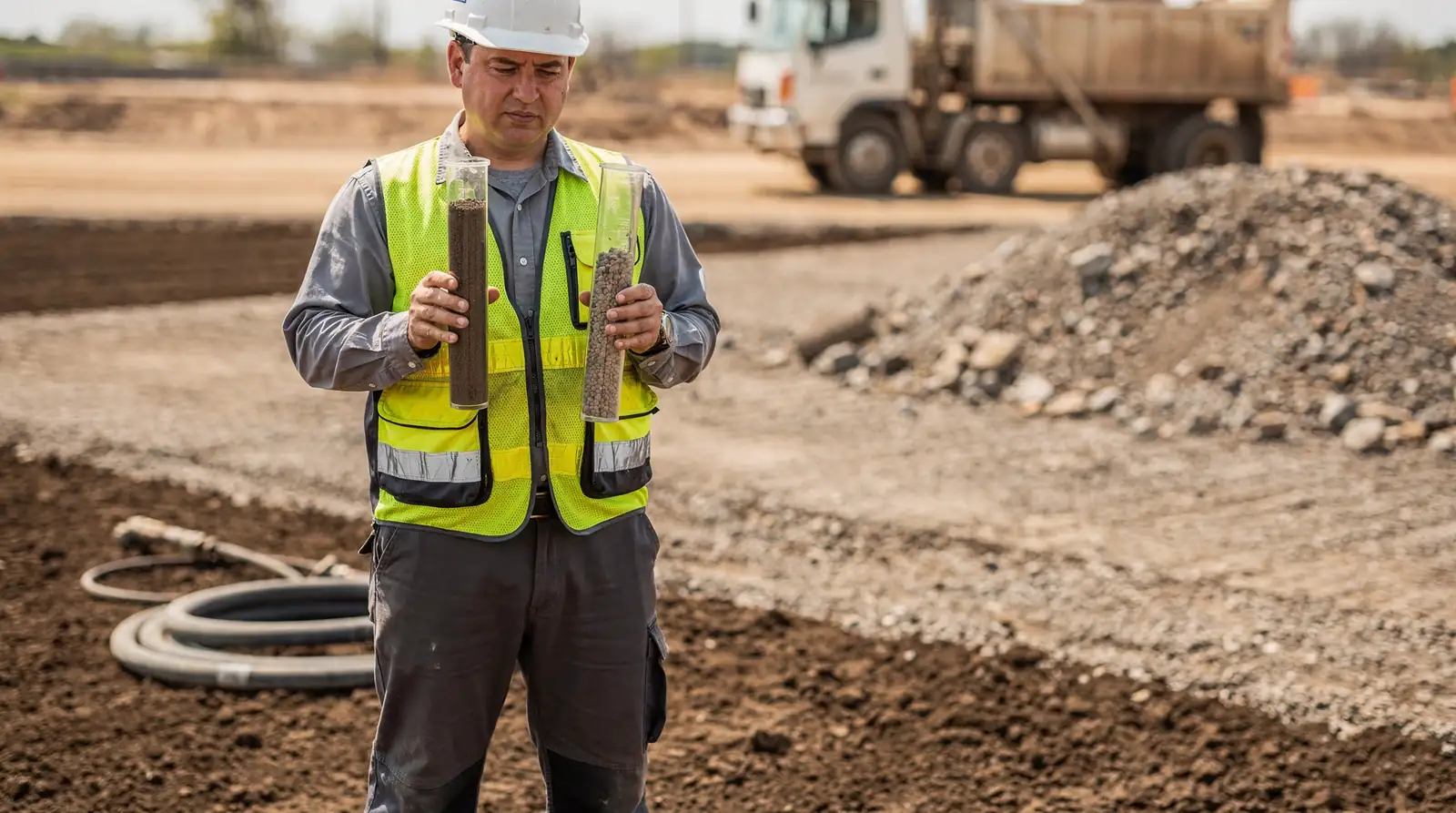
How does ionic injection compare to select fill?
Ionic injection permanently alters expansive clay at the molecular level. Select fill replaces the problem soil entirely through over-excavation and import of engineered material. These two approaches to soil stabilization cost savings differ fundamentally in execution, timeline, and long-term reliability.
The traditional select fill method requires contractors to dig out unstable clay, haul it offsite, and truck in compactable fill. This sequence generates significant trucking expenses and extends project schedules. In contrast, ionic injection treats the native soil in place. Roadresource.org notes that in-place stabilization reduces trucking costs and shortens construction time compared to removal and replacement. No material leaves the site. No new material arrives. The existing soil becomes the solution.
What makes ionic injection more efficient than select fill?
Speed and scale set the two methods apart. TX ProChem’s process handles up to 6,000 square feet per day per tractor, a production rate that keeps foundation pours and slab installations on schedule. Select fill operations move slower. Each truckload of excavated clay must depart before the next load of engineered fill arrives. Weather delays compound the problem. Rain turns open excavations into mud pits, stalling work for days.
How does the science behind ionic injection ensure permanent results?
The ProChem Ionic Liquid Stabilizer is a patented solution validated through a two-year study conducted by the University of Texas at Arlington. Researchers found the product changed the polarity of clay soils by removing their negative charge, a conclusion verified through electron microscopy. This molecular transformation renders the soil incapable of absorbing excess water. Select fill achieves stability through physical replacement alone. It does nothing to address moisture migration from adjacent untreated soils, leaving the new fill vulnerable to edge effects and differential movement over time.
For developers and engineers evaluating construction ROI soil treatment, the comparison sharpens further. Ionic injection eliminates the recurring cost per square foot stabilization burden tied to hauling, importing, and compacting foreign material. Projects that reduce stabilization costs through injection also avoid the hidden expense of schedule overruns. TX ProChem’s commercial soil stabilization services integrate directly into existing build sequences, treating expansive clay before it threatens structural integrity. The choice between injection and select fill ultimately hinges on whether a project team prefers to remove a problem or neutralize it permanently.
What is the ROI of treating soil before building?
Treating expansive clay before construction delivers measurable returns by preventing structural failure. Shifting clay soil does more damage to Texas homes and buildings than floods, tornadoes, and earthquakes combined, according to TX ProChem’s field data. That single fact reframes the investment decision for any developer or property owner.
The financial case rests on two pillars: avoided repair costs and extended asset life. Soil stabilization cost savings emerge immediately when builders skip the excavation, haul-off, and replacement cycle that select fill demands. TX ProChem’s injection method treats soil in place, eliminating trucking and disposal line items entirely.
How does soil treatment reduce long-term construction costs?
Increasing structural capacity through soil stabilization reduces total pavement thickness and increases pavement service life, per the Cost of Soil Stabilization resource. Thinner pavement sections mean less material, fewer labor hours, and faster project completion. Those savings compound across every square foot of a subdivision or commercial site.
Construction ROI soil treatment calculations also account for schedule certainty. TX ProChem’s permanent stabilization approach keeps the ground consistent irrespective of weather conditions. Contractors avoid rain-delay standstills and rework cycles that erode profit margins.
What is the cost per square foot for stabilization versus select fill?
A direct cost per square foot stabilization comparison favors injection in most Texas soil profiles. Select fill requires importing engineered material, compacting in lifts, and managing moisture content throughout placement. Injection treats the existing clay in place, addressing the root cause of foundation movement rather than masking it.
TX ProChem injects stabilizer directly into expansive clay soil, altering its behavior at the molecular level. The University of Texas at Arlington study documents reductions in plasticity index and swell potential that validate this approach. For developers weighing reduce stabilization costs strategies, the math favors treating soil once rather than managing its failure for decades.
Can you reduce stabilization costs with the right method?
Method selection directly controls soil stabilization cost savings on any project. The right approach eliminates unnecessary material waste, shortens construction timelines, and prevents the expensive structural failures that plague untreated expansive clay. Choosing poorly locks property owners and developers into a cycle of reactive repairs that drain budgets for decades.
TX ProChem delivers transparent proposals crafted to fit customer budgets and timelines. The company’s client-centered approach means every recommendation ties directly to the specific soil conditions on site, not a generic one-size-fits-all formula.
What drives the cost of chemical soil stabilization?
Three primary factors determine the total investment. According to an analysis by Tensar Corporation, the unit costs of the materials used and the cost of labor and equipment needed for installation form the core expense structure. These variables shift dramatically based on project scale, site access, and the stabilization method selected.
How does injection compare to select fill for cost control?
Developers who compare select fill vs injection quickly see the logistical advantages of chemical treatment. Select fill requires excavation, off-haul, import of engineered material, and compaction, each step adding trucking costs and days to the schedule. Injection-based stabilization treats the soil in place. TX ProChem’s workflow integrates smoothly with existing construction plans, avoiding the cascading delays that inflate budgets and frustrate stakeholders.
What makes a stabilization method cost-effective long-term?
True construction ROI soil treatment comes from permanence. A method that merely slows soil movement still leaves foundations vulnerable to seasonal moisture swings. TX ProChem’s ionic liquid technology alters expansive clay on a molecular level, a process detailed in the company’s Prochemical Soil Stabilization overview. This irreversible change locks the soil in place permanently. The cost per square foot stabilization figure becomes secondary when the alternative is a lifetime of structural monitoring and repair.
What is the cost per square foot for stabilization?
No universal per-square-foot price exists for soil stabilization. The final figure depends on raw material pricing, project size, and site conditions. TX ProChem’s process handles up to 6,000 square feet per day per tractor, which creates a scalable cost structure that reduces per-unit expense on larger sites.
Cost per square foot stabilization shifts with several variables. Raw material prices for the modifying or stabilizing agent directly influence the bottom line. Night work costs more for labor but results in fewer traffic disruptions, affecting the per-square-foot cost on commercial sites. Project size matters too. A 431,000-square-foot industrial development in Corsicana, Texas, demonstrates how large-scale soil treatment achieves efficiency through volume.
What factors drive the price up or down?
Three primary factors shape the final number:
- Raw material pricing: The stabilizing agent’s market cost fluctuates with supply conditions.
- Project size: Larger sites spread mobilization and equipment costs across more square footage.
- Work schedule: Night work increases labor costs but reduces traffic management expenses.
TX ProChem positions its ionic liquid treatment as a cost-effective solution compared to traditional methods. The daily treatment capacity of 6,000 square feet per tractor means fewer mobilization days and faster project completion.
How does injection compare to select fill on cost?
The compare select fill vs injection question hinges on total project economics. Select fill requires excavation, hauling, and replacement, which adds trucking and disposal costs. Injection treats soil in place, eliminating removal expenses. TX ProChem’s approach alters expansive clay at the molecular level without excavation, which reduces stabilization costs on projects where existing soil can remain in place.
How does soil stabilization prevent foundation repair costs?
Soil stabilization prevents foundation repair costs by permanently altering expansive clay at the molecular level. TX ProChem addresses the root cause of foundation damage, not just the symptoms. Shifting soil destroys structural integrity over time. A single season of heavy rain or extreme drought can shift the earth enough to crack a custom gunite shell. The financial consequences multiply quickly. Foundation repairs in Texas routinely reach five figures, and that expense recurs when underlying soil conditions remain untreated.
The company’s approach targets the mechanism that drives all clay-related damage. Expansive soil swells when wet and shrinks when dry. This cycle exerts tremendous pressure on slabs, footings, and pool shells. Traditional remediation methods address cracked concrete after the fact. TX ProChem stops the cycle before it starts.
How does molecular soil treatment eliminate swelling?
The ProChem Ionic Liquid Stabilizer alters the behavior of expansive clay on a fundamental level. The treatment changes the soil’s polarity. Treated ground becomes physically incapable of absorbing excess water. No water absorption means no swelling. No swelling means no pressure against the structure. The soil stabilization cost savings emerge immediately because the threat of movement disappears.
This permanent solution contrasts sharply with temporary fixes. Homeowners who invest in post-damage repairs without addressing the soil face repeated failures. Developers who skip pre-construction treatment risk callbacks and warranty claims. The construction ROI soil treatment calculation favors upfront stabilization every time.
What makes injection more reliable than select fill?
Builders often compare select fill vs injection when planning site work. Select fill replaces problematic soil with engineered material. That approach works in some scenarios but introduces new variables. Imported fill must be compacted perfectly. It must remain isolated from surrounding expansive clay. Water migration across soil boundaries can undermine the entire replacement over time.
Injection stabilizes the native soil in place. No excavation is required. No imported material is needed. The treated zone becomes permanently inert. For projects where cost per square foot stabilization drives decision-making, injection eliminates trucking costs, reduces construction time, and avoids the risk of fill contamination. The reduce stabilization costs benefit compounds when treating large residential subdivisions or commercial pads. TX ProChem’s process handles up to 6,000 square feet per day per tractor, compressing timelines and labor expenses into a single efficient operation.
What do developers need to know about construction ROI?
Construction return on investment begins underground. Construction ROI soil treatment transforms the financial model of a subdivision by eliminating the primary source of structural callbacks: expansive clay. TX ProChem helps developers reduce risks associated with Potential Vertical Rise (PVR). Project schedules remain uninterrupted. The result is a predictable build cycle and a finished product that stays sold.
How does soil treatment protect a developer’s reputation?
Reputational damage from shifting foundations erodes future sales faster than any single budget overrun. TX ProChem offers the heavy equipment and crew capacity to rapidly treat entire neighborhoods. Stabilizing the soil ensures developers hand over keys without worrying about underground movement ruining their reputation. Every home that avoids a foundation claim reinforces the builder’s brand in a competitive Texas market.
What makes TX ProChem’s approach a measurable ROI driver?
Measurable ROI comes from risk removal and schedule certainty. The company’s process addresses the root cause of soil movement at the molecular level, preventing the swell-shrink cycle that triggers costly structural repairs. Key financial advantages include:
- Reduced warranty claims: Permanent stabilization cuts the long-tail liability of foundation failures.
- Faster lot turnover: Treated soil allows construction to proceed without weather-related delays.
- Greater soil stabilization cost savings: Eliminating over-excavation and select fill import reduces direct sitework expense.
TX ProChem has over 30 years of hands-on experience across Texas, Louisiana, Mississippi, Arizona, and Oklahoma. That regional expertise translates into precise application rates and no wasted material. Developers gain a single, accountable partner who treats the ground before the first slab is poured, locking in both structural integrity and long-term profitability.
Is chemical injection worth the upfront investment?
Chemical injection delivers permanent soil stabilization that eliminates recurring foundation repair costs. A University of Texas at Arlington study validated the ProChemical Soil Stabilizer’s effectiveness on expansive clay.
The study documented a measurable reduction in the Plasticity Index of treated soil. Lower plasticity means the clay loses its capacity to swell and shrink with moisture changes. That single metric translates directly into soil stabilization cost savings over a structure’s lifetime.
Contractors weighing select fill vs injection face a clear tradeoff. Select fill requires excavation, hauling, and importing engineered material. Injection treats soil in place without removal.
TX ProChem’s permanent stabilization approach keeps ground consistent irrespective of weather conditions. The company is fully insured, fully licensed, and backed by three decades of results.
What drives construction ROI for soil treatment?
Construction ROI soil treatment improves when schedules hold and foundations stay intact. Injection avoids the delays tied to excavation and imported fill logistics. The cost per square foot stabilization reflects treatment speed and depth, not just material price.
For Texas property owners and developers, the upfront investment prevents the larger loss of structural damage later.
Conclusion
For property owners and developers evaluating soil stabilization cost and ROI, the decision comes down to whether a permanent molecular fix outweighs the certainty of recurring structural damage. TX ProChem’s injection eliminates the swell-shrink cycle at its source, delivering a measurable return through avoided repairs, faster construction timelines, and reduced warranty liability. The upfront investment secures a foundation that stays stable, making it the financially sound choice for any project built on expansive clay.