
Soil stabilization in Texas treats expansive clay at the molecular level, stopping the shrink-swell cycle that cracks foundations. TX ProChem injects its patented ProChem Ionic Liquid Stabilizer directly into clay, permanently locking soil in place. The process treats up to 6,000 square feet daily per tractor.
What is soil stabilization?
Soil stabilization is a construction process that improves the engineering properties of problematic soils so structures above them stay stable over time. Expansive clay ranks among the most common problem soils in Texas, and builders treat it before construction rather than after damage appears.
The work goes beyond simple drying or modification. According to Mintek Resources, stabilization generally requires a higher application rate and more thorough processing than drying or modifying a soil alone. That distinction matters because partial treatment leaves clay free to move again once moisture returns.
What are the basic steps of soil stabilization?
The sequence follows a predictable pattern on site:
Scarify or partially pulverize the existing soil.
Spread the selected chemical agent across the treatment area.
Add water and mix the agent thoroughly into the clay.
Compact the treated soil to maximum density.
Each step builds on the one before it. Poor mixing or shallow compaction undermines the entire treatment, which is why contractors control application rates closely.
Why does expansive clay treatment matter in Texas?
Texas leads the nation in foundation failures, and untreated expansive clay drives much of that movement. A ProChem field observation puts the risk plainly: without treatment, a foundation will move. Expansive clay treatment addresses the root cause by changing how the clay responds to water, rather than patching cracks after they form.
For Texas homeowners, property managers, and builders, the practical takeaway is timing. Treating soil before a slab, pool, or subdivision pad goes in costs far less than repairing a failed foundation later. The ProChem approach to building on solid ground targets that clay at the molecular level, and the ProChem soil stabilizer is engineered specifically for these conditions. Understanding how soil injection works helps clients evaluate whether a proposed treatment reaches the clay that actually causes movement.
Why is expansive clay treatment needed in Texas?
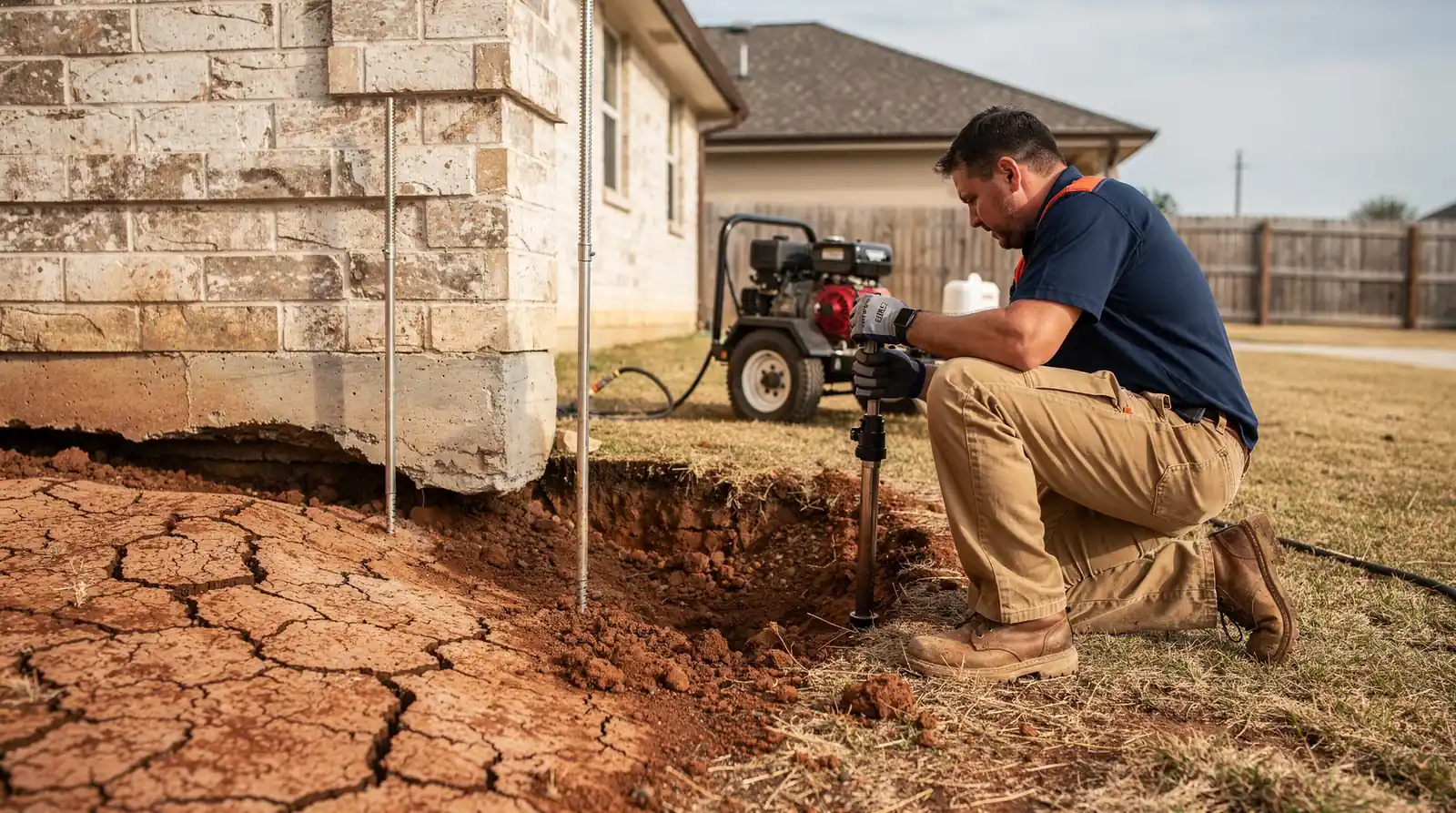
Texas soil presents a unique threat to every structure built upon it. Expansive clay treatment becomes essential because the ground itself moves, swells, and shrinks with enough force to crack foundations and shear walls. Shifting clay soil causes more damage to Texas homes and buildings than floods, tornadoes, and earthquakes combined, according to TX ProChem. The root of the problem lies deep in the soil chemistry.
What makes Texas clay soil so destructive?
The culprit is a mineral called montmorillonite. Expansive soils across Texas contain high concentrations of this clay mineral, which absorbs large quantities of water. This absorption causes the soil volume to increase significantly, a phenomenon known as heave. During dry periods, the soil loses moisture and shrinks, often forming deep cracks. This cyclical shrink-swell behavior exerts immense pressure on structures, leading to differential movement that can cripple a building.
How does North Texas clay behave differently?
North Texas contains high-plasticity CH clay, a particularly volatile soil type. CH clay swells dramatically when wet and shrinks severely when dry. This constant cycle of expansion and contraction causes major foundation movement. A permanent solution requires altering the soil’s molecular behavior rather than managing its moisture content. TX ProChem addresses this through a subsurface injection process that neutralizes the clay’s ability to absorb water, a method detailed in their analysis of the real fix for foundation problems in Texas.
The damage pattern is predictable but relentless. Wet seasons push foundations upward unevenly. Dry spells pull the supporting earth away, leaving voids beneath slabs. Neither concrete nor steel can resist this force indefinitely. Soil stabilization interrupts the cycle at its source, locking the clay in a permanently non-expansive state.
How do traditional stabilization methods compare?
Traditional stabilization relies on lime and cement to improve clay soils, and both additives demand thorough processing at higher application rates. The Portland Cement Association’s critical review of the literature documents this reliance on cement and lime for clay treatment. Texas contractors know the lime method well, often calling it the “Texas Two-Step” because the work proceeds in two stages: initial modification, then stabilization.
These methods deliver real improvement, yet they leave a gap. Lime and cement change the soil’s behavior without permanently altering its molecular structure, so the potential for future movement remains. For a Texas homeowner or property manager, that residual risk translates into foundation cracks that return after the next wet-dry cycle.
What is soil stabilization at the molecular level?
Soil stabilization describes any process that improves a soil’s strength and shrink-swell resistance. What is soil stabilization at the molecular level, though, differs from additive mixing. The ProChem soil stabilizer is a patented ionic liquid that targets the root cause of foundation issues by altering how clay behaves on a molecular level. A two-year study at the University of Texas at Arlington validated the technology.
How does soil injection work differently?
How soil injection works sets the ionic approach apart from surface mixing. Crews inject the stabilizer directly into expansive clay, where the liquid changes the soil’s behavior rather than merely coating it. Expansive clay treatment of this kind supports large-scale projects, including private industrial development work across Texas.
What is the ProChem soil stabilizer and how does it work?
The ProChem soil stabilizer is a patented ionic liquid treatment that permanently alters expansive clay at the molecular level. The formulation changes the soil’s polarity, rendering it physically incapable of absorbing excess water. This mechanism stops the destructive shrink-swell cycle that damages foundations across Texas. A two-year study conducted by the University of Texas at Arlington validated the technology’s effectiveness for Texas soil conditions.
Soil stabilization through this method differs fundamentally from traditional approaches. Rather than mechanically mixing additives or excavating and replacing problematic earth, the ProChem soil stabilizer is injected directly into the ground. The liquid permeates the clay formation and triggers a permanent electrochemical change. Once treated, the ground remains consistent irrespective of weather conditions. Droughts and heavy rains no longer cause the soil to contract and heave.
How does soil injection work for expansive clay treatment?
The expansive clay treatment process uses specialized tractors to inject the ionic stabilizer at precise depths. Each tractor treats up to 6,000 square feet per day. This throughput makes the method cost-effective for large-scale projects, from residential subdivisions to commercial pads.
The injection equipment delivers the stabilizer uniformly through the active zone of the clay. No soil replacement or mass excavation is required for stabilization. The treatment integrates directly with existing construction sequences, allowing builders to proceed without schedule disruption. For Texas property owners, this soil stabilization service eliminates the root cause of foundation movement rather than merely managing its symptoms.
How does soil injection work for permanent stability?
Soil stabilization through injection delivers a permanent fix by altering clay at the molecular level. The process targets expansive clay directly, stopping the destructive shrink-swell cycle that damages foundations across Texas.
What happens during a soil injection treatment?
The method applies a liquid stabilizer deep into the ground. Technicians inject the ProChem soil stabilizer directly into expansive clay, permanently changing how the soil responds to moisture. This approach addresses the root cause of foundation damage rather than merely managing symptoms.
For new construction, the sequence is straightforward. Crews treat the designated footprint prior to foundation excavation and leave the site ready for the dig team. The result is complete stability with zero delays to the build schedule.
Existing structures require a different technique. A hand-injection process secures the clay deep underground without disrupting landscaping. Flowerbeds, hardscaping, and established yards remain untouched throughout the treatment.
How does the treatment create permanent stability?
The answer lies in chemistry. Expansive clay treatment stops the endless cycle of swelling and shrinking for good. Once treated, the soil cannot absorb excess water. It stays consistent regardless of Texas weather patterns, from summer drought to spring deluge.
The process works on a molecular level. The ionic liquid alters the polarity of clay particles. This renders the soil physically incapable of the volume changes that crack slabs and shift foundations. The stabilization is permanent because the chemical change does not degrade or wash out over time.
Conclusion
For Texas property owners facing the relentless damage of expansive clay, the choice is clear: address the root cause with a permanent molecular-level solution or continue managing recurring foundation cracks. Soil stabilization through ionic injection delivers lasting stability, eliminating the shrink-swell cycle that traditional methods leave unresolved. This approach secures your investment against Texas’s unpredictable climate, making it the definitive next step for any construction or remediation project.